Why an asbestos register sitting in a folder is not enough
Asbestos is hardly a new health and safety issue. Yet in 2026, the Health and Safety Executive is still finding significant weaknesses in the way organisations manage asbestos within their premises.
HSE has specifically highlighted shortcomings including asbestos management plans not being in place and inadequate information, instruction and training. Inspectors visiting premises and construction sites continue to check whether asbestos is being properly managed. HSE Media Centre
That raises an important question for anyone responsible for an older building:
Do you actually manage your asbestos risk — or do you simply have an asbestos survey?
There is an important difference.
The survey is the starting point
For buildings constructed or refurbished before 2000, asbestos should be assumed to be present unless there is evidence demonstrating otherwise. HSE guidance requires dutyholders to identify asbestos-containing materials, record their location and condition, assess the potential for exposure and establish arrangements for managing the risk. HSE
An asbestos survey can provide much of the information needed to begin that process.
But commissioning a survey does not, by itself, manage anything.
The information has to be understood, maintained and — most importantly — communicated to the people who could disturb the material.
The asbestos register needs to be a live document
Buildings change.
Materials deteriorate. Contractors undertake repairs. Services are modified. Walls are drilled. Ceilings are opened. Equipment is replaced and refurbishment projects take place.
An asbestos register created several years ago and never reviewed may therefore provide a false sense of security.
HSE describes the asbestos register as a live document containing current information about the presence and condition of known or presumed asbestos-containing materials. HSE
The associated management plan should identify responsibilities, monitoring arrangements, controls to prevent disturbance, arrangements for providing information to workers and contractors, and emergency procedures should asbestos-containing material be accidentally disturbed. HSE
That turns a survey into a management system.
The contractor arriving tomorrow is where the system gets tested
Consider a relatively simple maintenance activity.
An electrical contractor arrives to install new equipment and needs to drill several holes through an existing wall.
The building has an asbestos survey.
But has the contractor seen it?
Does the survey cover the area where drilling will take place?
Could asbestos be concealed within the wall construction?
Has anyone checked before issuing the work instruction or permit?
This is where paperwork and reality can become disconnected.
HSE requires information about asbestos to be provided to those who could disturb it, including construction contractors, electricians, plumbers, heating and ventilation engineers and maintenance personnel. HSE
The information needs to reach the person doing the work before the material is disturbed.
Management surveys and refurbishment surveys are not interchangeable
Another potentially serious mistake is assuming that an existing management survey is sufficient for refurbishment or intrusive construction work.
It may not be.
A management survey is primarily concerned with asbestos that could be disturbed during normal occupation and routine maintenance.
Refurbishment can involve opening walls, ceilings, floors, ducts and other parts of the building that were previously inaccessible.
HSE states that installation or refurbishment work disturbing building fabric where asbestos could be hidden requires a more intrusive survey before work starts. HSE
The scope of the survey therefore needs to reflect the scope of the work.
Asbestos should form part of pre-construction planning
For construction projects, asbestos information is also an important element of pre-construction planning.
Before contractors arrive on site, the project team should understand what information exists, whether it is adequate for the proposed work and whether additional investigation is required.
Questions worth asking include:
When was the building constructed?
What asbestos information already exists?
Does the survey cover the areas affected by the proposed work?
Have previously inaccessible areas now become accessible?
Who will communicate the information to contractors?
How will the information link with RAMS, permits and site controls?
Finding the answers before construction begins is considerably easier than dealing with an uncontrolled disturbance afterwards.
What happens when asbestos is left in place?
Finding asbestos does not automatically mean it needs to be removed.
Where asbestos-containing materials are in good condition and unlikely to be disturbed, HSE advises that leaving them in place and managing them can often be safer. Their condition must then be monitored and relevant people informed about their location. HSE
The important word is managed.
Someone needs to own the process.
The health consequences are long-term
One reason asbestos risk can become underestimated is that exposure does not normally produce an immediate injury.
The consequences can appear decades later.
HSE’s current headline statistics record 2,146 mesothelioma deaths in Great Britain in 2024 resulting from past asbestos exposure. HSE
Today’s controls therefore protect people from diseases that may not become apparent for many years.
That makes good asbestos management an important part of responsible building and project management.
From document to control
The real measure of an asbestos management system isn’t whether an organisation can produce a survey when asked.
It’s whether the electrician about to drill a wall, the engineer opening a ceiling void or the contractor beginning refurbishment work has been given the right information before starting work.
At Adept Safety, we believe health and safety documentation should translate into practical controls at the point where work is undertaken.
An asbestos survey identifies the hazard. Effective management prevents someone from disturbing it.
Temporary hero image
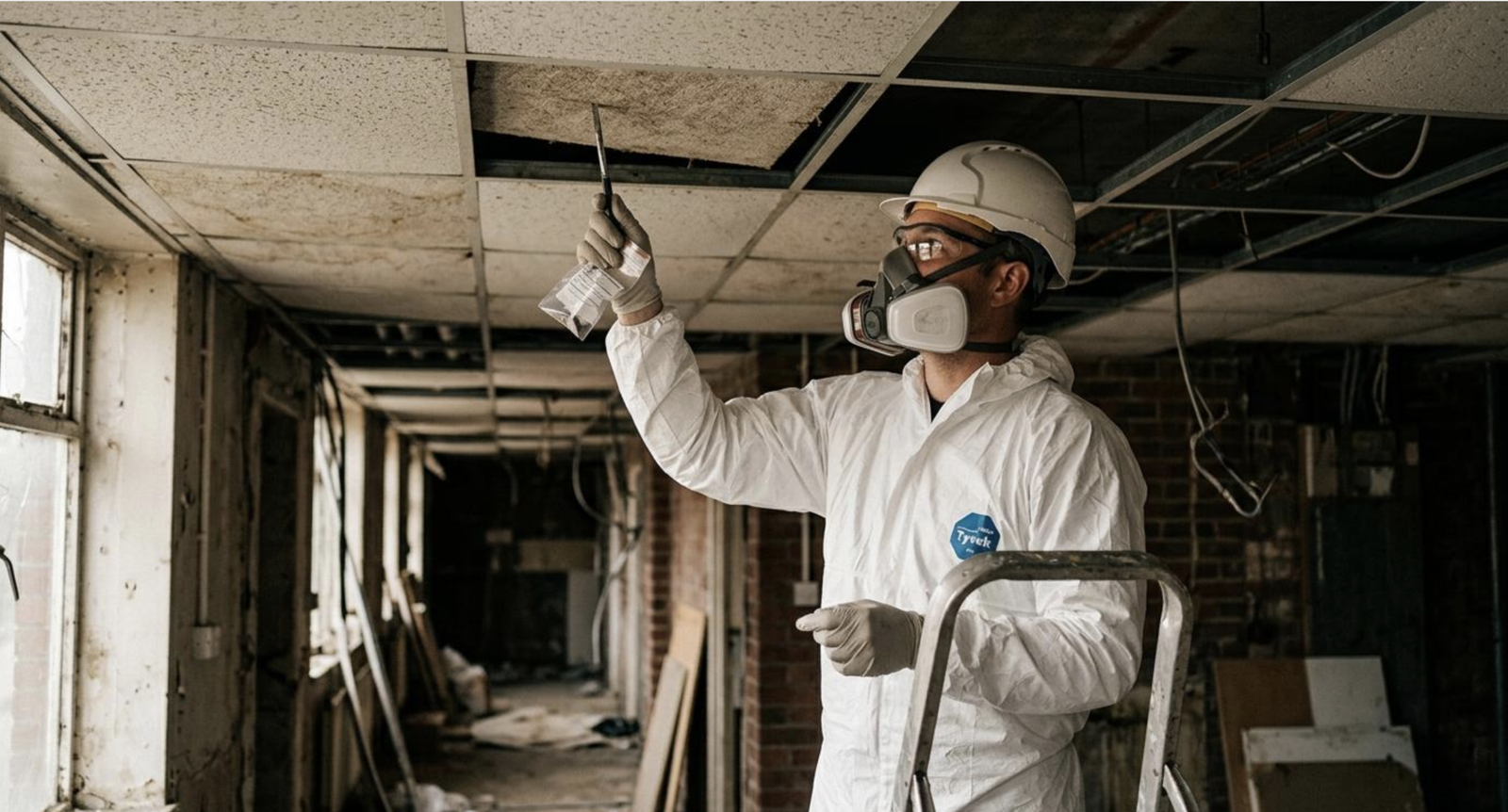
For this one I would use imagery of an industrial/building survey rather than dramatic asbestos removal. That better reflects the message of the article: identify, record and manage.
A suitable visual style would be a surveyor/engineer in PPE and respiratory protection inspecting existing building fabric, preferably in a darker industrial environment.
I wouldn’t recommend the asbestos images returned in the general image search because their reuse rights aren’t sufficiently clear.
A temporary Pexels alternative could instead use a worker in appropriate PPE/respiratory protection; Pexels marks this image as Free to use: