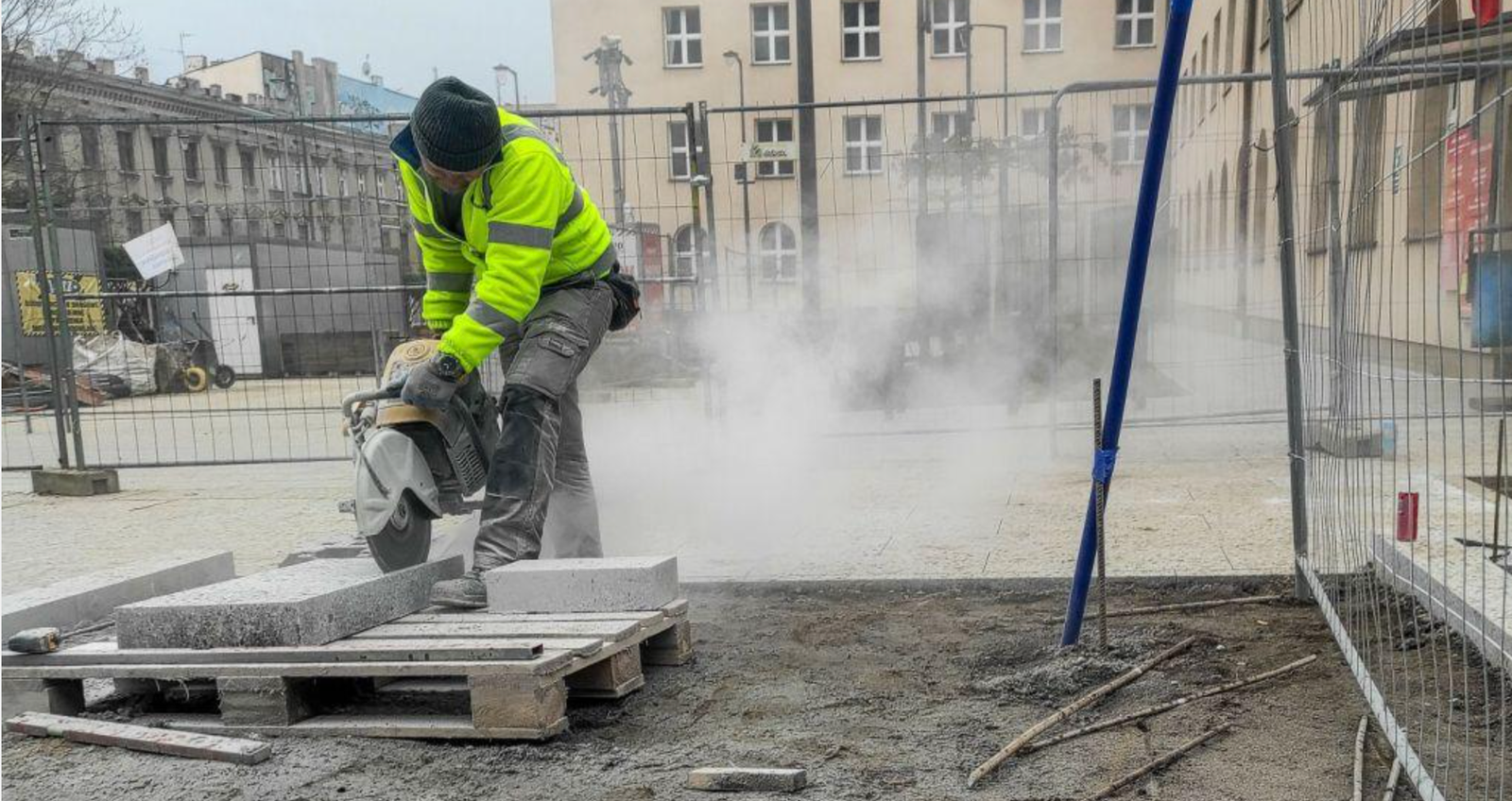
Why controlling dust at source matters more than simply handing out a mask
Walk onto many construction sites and dust can almost appear to be part of the job.
Cutting concrete, chasing walls, drilling, grinding, demolition and handling certain materials can all create airborne dust.
The fact that an activity is commonplace, however, does not make the exposure acceptable.
In 2026, HSE has placed renewed emphasis on exposure to respirable crystalline silica (RCS), including a nationwide inspection programme focused on engineered stone. Its latest guidance makes clear that dry cutting engineered stone is unacceptable and that suitable water suppression should be used to meet legal requirements. HSE Media Centre
The underlying lesson extends beyond engineered stone.
Dust needs to be controlled where it is created.
Not all dust is simply a nuisance
Construction dust can contain materials capable of causing serious occupational disease.
Activities involving concrete, sandstone, mortar, bricks, tiles and other silica-containing products can generate very fine respirable crystalline silica particles.
Unlike the visible clouds of larger dust particles we associate with dirty construction work, the smallest respirable particles can penetrate deep into the lungs.
Repeated exposure can result in serious and potentially irreversible disease.
This is why construction dust should be treated as an occupational health risk rather than simply a housekeeping problem.
HSE is taking enforcement action
This isn’t merely theoretical guidance.
In June 2026, HSE announced that four businesses had been served with Prohibition Notices during its engineered-stone inspection campaign because inspectors found inadequate measures for controlling exposure.
The notices required the work to stop immediately until suitable improvements had been made. HSE Media Centre
That provides a useful reminder to the wider construction industry.
Where an activity produces hazardous dust, simply accepting that “it’s a dusty job” isn’t an adequate control measure.
Start by eliminating the dust
As with most health and safety risks, PPE should not be the first question.
Before selecting a respirator, consider whether the dust can be prevented from being generated.
Could components be supplied pre-cut?
Could a different material or process be used?
Could fabrication take place under better-controlled conditions away from the workface?
Could drilling or cutting be reduced through better design and coordination?
These decisions can remove exposure altogether.
Where dust generation cannot reasonably be eliminated, the next priority should be controlling it at source.
Wet cutting and extraction
Two of the most important approaches are water suppression and local extraction.
Applying water at the cutting point can suppress dust before it becomes airborne.
Suitable on-tool extraction can capture dust close to where it is generated.
Which method is appropriate depends upon the material, equipment and activity, but the principle remains the same:
Don’t allow a cloud of hazardous dust to develop and then rely solely on PPE to protect the person standing inside it.
The control should act as close to the source as reasonably practicable.
What about respiratory protective equipment?
Respiratory protective equipment can still form an important part of the control strategy.
But simply issuing disposable masks isn’t enough.
The equipment needs to be appropriate for the hazard and exposure. Tight-fitting respiratory protection needs to fit the individual correctly, and workers need to understand how it should be worn, checked and maintained.
Facial hair can also prevent some tight-fitting respirators from achieving an effective seal.
RPE should therefore support suitable engineering controls — not automatically replace them.
Look beyond the person operating the tool
Another common weakness is focusing exclusively on the person undertaking the activity.
Imagine someone cutting concrete with a disc cutter.
They may be wearing respiratory protection.
But what about the electrician working ten metres away?
The supervisor walking through the area?
People working downwind?
Dust does not respect work boundaries.
The risk assessment therefore needs to consider everyone who could be exposed, not simply the operator.
That may require segregation, exclusion zones, ventilation, changes to the work sequence or relocating the activity.
Housekeeping matters too
Dust deposited on floors, equipment and surfaces hasn’t necessarily stopped being a hazard.
Dry sweeping or using compressed air can simply put settled dust back into the atmosphere.
Good dust management therefore needs to consider how the work area will be cleaned as well as how the original activity is controlled.
Suitable industrial vacuum equipment and controlled cleaning methods can prevent yesterday’s dust becoming today’s airborne exposure.
Occupational health deserves the same attention as safety
Construction is very good at recognising hazards capable of causing an immediate injury.
A person working near an open edge attracts attention because everyone understands the consequence of falling.
Occupational health hazards can be less visible.
There may be no immediate injury following exposure to dust, noise, vibration or hazardous substances.
The consequences may develop gradually.
That difference should not result in occupational health receiving less attention.
The absence of an immediate accident doesn’t mean that harm isn’t occurring.
What should site managers be looking for?
Walk around the project and look at the work rather than simply the paperwork.
Is visible dust being generated?
Are materials being dry-cut unnecessarily?
Is extraction actually connected and operating?
Is water suppression reaching the cutting point?
Are other workers being exposed?
Is the RPE appropriate and being worn correctly?
How is the work area being cleaned afterwards?
And perhaps most importantly:
Does the method described in the RAMS match what is actually happening on site?
That final question applies to almost every aspect of effective health and safety management.
Control the hazard, not just the worker
Good occupational health management should aim to prevent exposure rather than simply equip workers to tolerate it.
At Adept Safety, our approach is to look beyond paperwork and consider how activities are actually planned and undertaken — identifying practical opportunities to eliminate hazards, control exposure and ensure agreed arrangements are being implemented.
If you can see the dust, ask why it’s there. The best control is the one that prevents it becoming airborne in the first place.